After leaving The Kinks, Quaife founded a new band, the country/rock outfit, Mapleoak. The group's name derived from the heritage of its members: The 'Maple' represented the two Canadian members of the group (singer-songwriters Stan Endersby (born 17 July 1947, in Lachine, Quebec, Canada) and Marty Fisher (born 24 December 1945, in Vancouver, British Columbia, Canada), while the 'Oak' represented British members Quaife and drummer Mick Cook.
Read More here
Original Kinks bassist and band co-founder Pete Quaife has died at the age of 66 -- the cause of death is as yet unconfirmed although the BBC website reports he had been undergoing kidney dialysis for over ten years.
Quaife quit the Kinks in 1969 before going on to form his own band a few months later but Mapleoak never came close to achieving the success his former outfit enjoyed.
Quoted at the time as being unhappy with life in the Kinks, partly because of the tensions between brothers Ray and Dave Davies, Quaife ended his five-year stint in the band only to return for a one-off reunion show in Canada in 1981.
A fully-fledged reunion was mooted at the time but never came to fruition.
However it wasn't all negative for Quaife during his Kinks tenure. The highlight came with the recording of the 1968 'Village Green Preservation' album. Speaking to Jukebox magazine in 2006 the bassist recalled, "Making that album was the high point of my career. For me it represents the only real album made by the Kinks ... in which we all contributed something." BBC NEWS
After leaving The Kinks, Quaife founded a new band, the country/rock outfit, Mapleoak. The group's name derived from the heritage of its members: The 'Maple' represented the two Canadian members of the group (singer-songwriters Stan Endersby (born 17 July 1947, in Lachine, Quebec, Canada) and Marty Fisher (born 24 December 1945, in Vancouver, British Columbia, Canada), while the 'Oak' represented British members Quaife and drummer Mick Cook.
Quaife had contacts in Denmark, so the group gigged heavily there and in the UK during most of 1969 and early 1970. Cook left the band in June 1969, and was replaced by another Canadian: Gordon MacBain (born 5 August 1947, in Toronto, Ontario, Canada), who would write most of the group's original material.
Mapleoak released their first single, "Son of a Gun", in April 1970 but it failed to chart. Quaife then left both the band and the music industry. He subsequently moved to Denmark, and did not appear on Mapleoak's only album, which was released in 1971.
Third Ear Band evolved within the London alternative and free-music scene of the mid 1960's with members coming from The Giant Sun Trolley & The People Band to create a uniquely improvised music drawing on Easternraga forms, European folk, experimental and medieval influences.They recorded their first session in 1968 for Ron Geesin which was released under the pseudonym of The National-Balkan Ensemble on one side of a Standard Music Library disk. Their first actual album, Alchemy, was released on the EMIHarvest label in 1969, (featuring John Peel playing Jew's Harp on one track), followed by Air, Earth, Fire, Water (aka Elements) in 1970. They recorded two soundtracks, the first in 1970 for an animated film by Fuchs of Abelard and Heloise (which first saw release as part of Luca Ferrari's Necromancers of the Drifting West Sonic Book in 1997) and then in 1971 for Roman Polanski's film of Macbeth. After various later incarnations & albums they finally disbanded in 1993 owing to leader & percussionist Glen Sweeney's ongoing health problems.
They also opened the Rolling Stones Free Concert at Hyde Park on 5th July 1969.(From Wikipedia) ~~~~~~~~~~~~~~~~~~~~~~~~@~~~~~~~~~~~~~~~~~~~~~~~~~~
Third Ear Band- Hyde Park {Live 1970}
Paul Minns: oboe, recorder
Glen Sweeney: drms,Percussion
Paul Buckmaste: cello, bass guit
Simon House: violin, VCS3
Denim Bridges: guitars
Lyn Dobson: soprano saxophone, flute, vocals
Ursula Smith: cello, violin
Richard Coff: Violin, Viola
(included16 tracks)
1. Overture 2. The Beach 3. Lady Macbeth 4. Inverness: Macbeth's Return/The Preparation/Fanfare/Duncan's Arrival 5. The Banquet 6. Dagger And Death 7. At The Well/The Princes' Escape/Coronation/Come Sealing Night 8. Court Dance 9. Fleance 10. Grooms' Dance 11. Bear Baiting 12. Ambush/Banquo's Ghost 13. Going To Bed/Blind Man's Buff/Requiscant/Sere And Yellow Leaf 14. The Cauldron 15. Prophesies 16. Wicca Way
The unique style of Third Band is most worked out here in shorter tracks, more and brighter ideas. Most beautiful (and an absolute classic) is the song sang by a boy,"Fleance" and the bird song like passages, like "Court Dance", and the medieval inspired like passages. Oboe sound again most beautiful. A few passages are more experimental. Within the rest of the music full of clarity these little parts are not easy. This release is the music for the Roman Polanski film.
The album was originally issued on the Harvest label, it was reissued on BGO and later with a different cover on Voiceprint. (psychedelic folk)
Quintessence The fifth essence. The ancient Greeks said there are four elements or forms in which matter can exist- fire, or the imponderable form; air, or the gaseous form; water, or the liquid form; and earth, or the solid form. The Pythagoreans added a fifth, which they called ether, more subtile and pure than fire, and possessed of an orbicular motion. This element, which flew upwards at creation, and out of which the stars were made, was called the fifth essence; quintessence therefore means the most subtile extract of a body that can be procured. It is quite an error to suppose that the word means an essence five times distilled, and that the term came from the alchemists. Horace speaks of "kisses which Venus has imbued with the quintessence of her own nectar.""Swift to their several quarters hasted thenThe cumbrous elements- earth, flood, air, fire;But this ethereal quintessence of heavenFlew upward ... and turned to starsNumberless as thou seest." Review
by Richie Unterberger
While Quintessence's second album had a guileless sincerity to its spiritual striving that was uncommon in pop music, it's very much a relic of its hippie age. The good points? An uncalculated, genuine wish to both reflect the era's ideals and to use its music as a tool to achieve them, as well as a willingness to blend aspects of jazz,
Indian music, and religious invocation into an overall psychedelic-progressive rock structure (complete with flute and some acid rock guitar). The bad points? An absence of conventional songwriting chops, exacerbated by the band's tendency to ramble on in formless jam-like passages, though actually none of the tracks here exceed six minutes. Certainly it's eclectic, with a commune-like vibe permeating the proceedings, though the recording's quite professional. "Jesus, Buddha, Moses, Gauranga" sounds rather akin to the We're Only in It for the Money-era Mothers of Invention, though minus any hint of satire or irony in the over the top beatific lyrics. Overall, though, it feels a little like listening to the house rock band of a pan-religious cult that doesn't have anything of particular value to sell. The 2004 CD reissue on Repertoire adds a live version of "Jesus, Buddha, Moses, Gauranga" (originally released on the first pressing of the 1970 Island compilation Bumpers) as a bonus track.
Quintessence (English band)
From Wikipedia, the free encyclopedia
Quintessence was a band formed in April 1969 by Raja Ram in Notting Hill, London, England. The style was a mixture of jazz and progressive rock with an influence of music from India. This trend in music started by Quintessence would later resurface in the 1990s in the form of Goa trance.
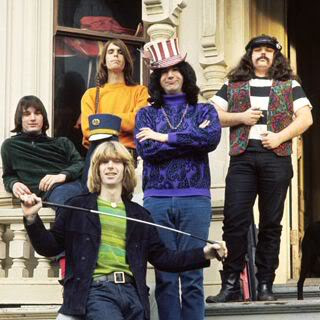
Quintessence were formed in April 1969 by Raja Ram in Ladbroke Grove, Notting Hill. They played a hybrid of jazz, progressive rock and Indian Music. The original line-up included Shiva Jones (voice, keys, percussion), Raja Ram (flutes, percussion), Sambhu Baba (bass, guitar), Maha Dev (guitar), Allan Mostert ((guitar), and Jake Milton (drums, percussion). Quintessence were tagged a 'spiritual' band and were playing new age rock before the term was born.
Although their evangelism in retrospect might seem to be a bit over the top, the music retains its beauty created by some highly individual souls. They rehearsed in All Saints Hall which was a converted church near Portobello Road, and recorded 3 albums for Island Records between 1969 and 1971. two further albums were recorded in 1972 for RCA. The 'Self' entitled first of these was their best with studio material on side one, and the band playing live at Exeter University December 11, 1971 on side two. Their live set was usually mostly improvised as they avoided playing the same riff twice or going into a routine thing. Not unlike the Grateful Dead, they did a lot of collective jamming with an intention to trance out their colourful audiences by a forceful combination of the chanting of mantras with the Krishna flute lines and the lyrical guitar soloing. Often the local Hare Krishna disciples would provide an extra percussion section to the already steamy proceedings. Quintessence had their household guru in Swami Ambikananda. They built a reputation on solid club work and were deemed London's Underground Sensation in 1970. Besides appearing at the first two Glastonbury Festivals (then called 'Faires'), in 1970/71, they also were invited to play the Montreux Jazz Festival at a time when jazz was still being played there. At their peak they sold out the Royal Albert Hall twice.
Although Quintessence played many hundred of concerts and festivals all over Europe, they never made it to the United States. Although a concert at New York's Carnegie Hall was already lined up in early 1972, they didn't make it because Shiva and Maha Dev were asked to leave the band by Raja Ram in spring 1972. Shiva and Maha Dev went on to form the short-lived outfit called Kala. With ego clashes and problems on many frontiers, Kala quickly folded and Quintessence, now trying to make it the body without a head, and bereft of a sense of purpose, direction and being victims of the changing times, played on into the eighties, then slowly drifted into limbo.
Jake Milton went on to form Blurt with his brother Ted Milton.
(Maha Dev) has recently released his first solo album.
"The band turned down a US record deal negotiated by Chris Blackwell (Island Records) and didn't play at Carnegie Hall or tour the USA because four of its members wanted a larger monetary advance. This disappointed Chris Blackwell greatly and he dropped the band from the label. The band signed with RCA and recorded one album with Shiva and Maha Dev. Raja Ram unexpectedly 'fired' Shiva and Maha Dev after that album with RCA was recorded.
"The 'real' reason that Shiva's band Kala broke up was because Bradley's Records (a subsidiary of ATV) changed their policy towards their artists. They no longer wanted bands to make albums and insisted on them being singles pop artists. They wanted Shiva to wear a 'glitter suit', and when he refused, the senior management of ATV broke up the band by taking all of the equipment back and canceling their dates. It had nothing to do with 'ego' clashes. I don't know where this 'Nik' got his info from." - directly quoted from Shiva/Phil Jones
Sambhu Babaji Bass
Dave Codling Guitar
Shiva Shankar Jones Keyboards, Vocals
Jake Milton Drums
Alan Mostert Guitar
Raja Ram Flute, Piano, Vocals
Biography
by Bruce Eder
Quintessence was among the first true progressive rock outfits signed by Island Records. Led by Australian-born Shiva Shankar Jones (keyboards, vocals) and Raja Ram (flute, violin, percussion), the group also included Alan Mostert (lead guitar), Sambhu Babaji (bass), Maha Dev (guitar), and Jake Milton (drums), all of whom, in addition to a common interest in Indian music, also shared the Hindu faith.In Blissful Company, out before the end of the year. Its mix of rock, jazz, and Indian elements was popular enough at the time with their core audience, especially one track entitled "Notting Hill Gate," a tribute to the hippie community, which found a slightly wider audience; the band subsequently recut the song in a more pop-oriented rendition as a single.
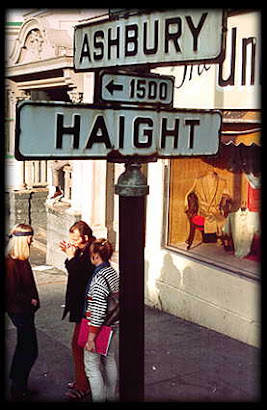
The group's roots lay in the hippie community in the Notting Hill area, which was to London roughly what Haight-Ashbury was to San Francisco. Their breakthrough performance took place at a festival called Implosion, where they put on a good enough show to get noticed by Island Records, which signed them and got their debut LP, an elaborately packaged concept album entitled
The group had a strong reputation from their live work, and their early recordings seemed to build from this base. Quintessence's career reached its commercial peak with their self-titled second album, which got to number 22 on the U.K. charts. They did one more album for Island and then jumped to RCA's new British progressive rock Neon imprint for two LPs in the early '70s. Jones departed soon after the release of the group's second album for the new label, and they split up not long after that. In 1973, Jones became part of the big-band progressive outfit Kala, which recorded one album for the Bradley's label, and in subsequent decades he restarted his own version of Quintessence.
The word ommadawn appears to be related to the Irishword amadán meaning or "idiot" or "fool". This interpretation is consistent with Clodagh Simmons pre-translation english lyrics of the gaelic chant at the end of the first movement:Daddy's in bed, The cats drinking milk, I'm an idiot, And I'm laughing
Mike Oldfield: harp, electric, acoustic, classical and twelve-string guitars, acoustic and electric basses, mandolin, bodhran, bazouki, banjo, spinet, grand piano, electric organs, synthesizers, glockenspiel, assorted percussion. Not listed but believed to be there...Eeectric lap steel guitarPaddy Moloney: uillean pipes.Herbie: northumbrian bagpipes.Leslie Penning: recorders.Terry Oldfield: pan pipes.Pierre Moerlen: timpani.David Strange: cello.Don Blakeson: trumpet:William Murray: percussion.Julian Bahula, Ernest Mothle, Lucky Ranku, Eddie Tatne (Jabula): African drums.Clodagh Simonds, Bridget St John, Sally Oldfield, The Penrhos Kids (Jason, Abigail, Ivan and Briony Griffiths): vocals.The Hereford City Band conducted by Leslie Penning.
Produced and Engineered by Mike OldfieldRecorded at The Beacon January - September 1975 African drums recorded at The Manor.
This group is one of the earliest prog group from all of Scandinavia (their first album was recorded in 69 but the group has roots from 68) although they were hardly classic Psychedelic progressive, playing a very wide spectrum of music from jazzy stuff to blues via folk and rock. All four albums are very constant in the crazy Finnish way of playing progressive music, but you will have a hard time to find their second album - the only one not to be released on Love Record under which recorded TABULA RASA and FINNFOREST as well as WIGWAM a band that could they (TASAVALLAN PRESIDENTITI) be compared to. Their last album was more similar to COLOSSEUM
Line-up/Musicians -
Jukka Tolonen / guitar, piano
Juhani Aaltonen / saxophone, flute
Frank Robson / vocal, piano, organ
Mans Groundstroem / bass, organ
Vesa Aaltonen / drums
This also (As many of us already know) one of the first rock albums recorded in Finland. I think that only Blues Section recorded before Tasavallan presidentti, being also released around the same time as Hard 'n' Horny by another finnish rock band Wigwam.
Anthony Phillips was one of the founding members of Genesis, having
attended the Charterhouse School in Surrey with Peter Gabriel, Tony
Banks, and Michael Rutherford. Phillips and Rutherford (who had
played together in another band before linking up with Gabriel and
Banks), were the principal composing members of Genesis during their
formative years, right into their first recording venture on English
Decca ("Silent Sun" etc.) under the aegis of Jonathan King. Much of
Phillips' and Rutherford's music was too subtle and introspective to
work for the fledgling band on stage, and eventually composition became
more of a shared effort.
Anthony and Mike Rutherford played guitars
on every song along with various keyboards and percussion.
John Hackett (yes, Steve's brother) -- flute,
Viv McAuliffe -- vocals,
and Phil Collins on vocals
By the time the group cut its second album, Trespass, however, Phillips had receded into the background, propelled by a crippling onset of stage-fright that forced him out of the line-up following the album's release. His influence, ironically, was felt very strongly on their subsequent breakthrough third album, Nursery Cryme, the title track of which (the band's first number to attract a wide audience in progressive rock circles), for its introduction and opening minute, used material that Phillips had written and recorded (as a demo) as early as 1969.
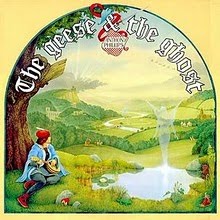
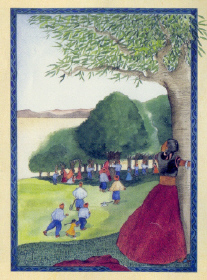
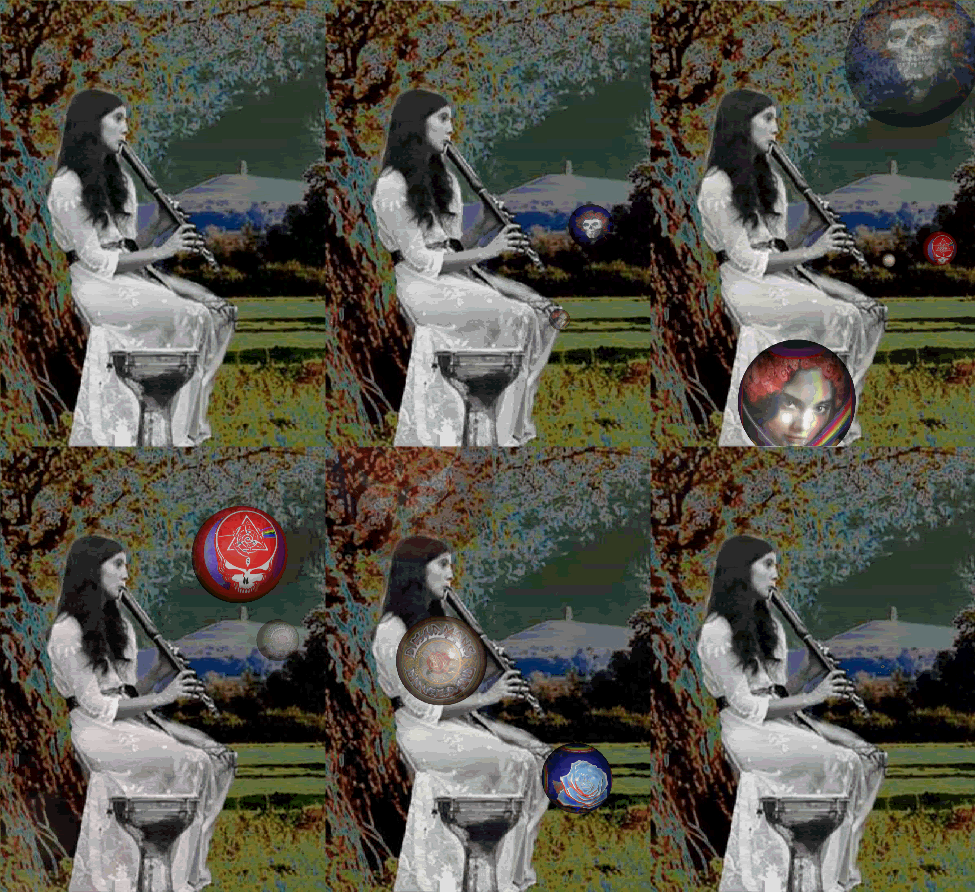
A solo album by an early Genesis member. A very orchestral, yet lyrical album. The theme flows throughout the songs and stands together as a complete piece. The cover art is a lovely pastoral view of the minstrel serenading the ghost in question. This is a great find for Genesis and progressive fans alike.
ralfaz-archives.com
Little more was heard from Anthony Phillips until 1977, when he favored us with his first solo album, The Geese and the Ghost, followed by Wise After the Event a year later, and then a collection of early demo recordings, Private Parts and Pieces, also issued in 1978. Phillips has re-emerged periodically, working in a style that is much closer to the classically influenced original Genesis sound than to the work of the current version of the group.
He retains a cult of fans, similar in certain respects to Peter Banks of Yes (another guitar player who quit an art-rock band at a critical early juncture in their history), but recording more frequently. He also writes a considerable amount of music for television and movies, and remains a guitarist of supreme skill and confidence, steeped in classical, pre-Baroque, and folk influences, able to record entire albums featuring only his acoustic instrument. Phillips' skills on the keyboard, principally synthesizer and Mellotron, are more limited, and were never exploited within a group context, but his studio recordings reveal a distinctive character to his compositions on those instruments as well. ~ Bruce Eder, AMG
01 - Wind - Tales 00:01
02 - Which Way The Wind Blows 01:04
03 - Henry; Portraits From Tudor Times 06:56
I - Fanfare
II - Lutes' Chorus
III - Misty Battlements
IV - Henry Goes to War
V - Death of a Knight
VI - Triumphant Return
04 - God if I Saw Her Now 20:59
05 - Chinese Mushroom Cloud 25:14
06 - The Geese and the Ghost26:00
Part I°
Part II°
07 - Collections41:51
08 - Sleepfall: The Geese Hy West 44:59
CD2 outtakes
01 - Master of Time ( Demo ) 52:36
02 - Title Inspiration
03 - The Geese and the Ghost - Part one ( basic track )
04 - Collection Link
05 - Which Way the Wind Blows
06 - Silver Song ( basic track )
07 - Henry: Portraits From Tudor Times ( basic track )
I - Fanfare , II - Lute's Chorus , III - Lute's Chorus Reprise , IV - Misty Battlements
08 - Collections ( demo )
09 - The Geese & The Ghost - Part Two ( basic track )
10 - God If I Saw Her Now ( basic track )
11 - Sleepfall ( basic track )
12 - Silver Song ( Unreleased single version, 1973 )
“All we have to decide is what to do with the time that is given us.”
Debtocracy: Ένα ντοκιμαντέρ για την κρίση
Για πρώτη φορά στην Ελλάδα, ένα ντοκιμαντέρ με παραγωγό το θεατή. Το Debtocracy/ Χρεοκρατία αναζητά τα αίτια της κρίσης χρέους και προτείνει λύσεις που αποκρύπτονται από την κυβέρνηση και τα κυρίαρχα μέσα ενημέρωσης.
Το δόγμα του σοκ !
Το δόγμα του σοκ και η άνοδος του καπιταλισμού της καταστροφής: το βίαιο παρελθόν της πλέον κυρίαρχης ιδεολογίας της εποχής μας.
Φόβος: Ουσιαστικό. Αλλά και ουσιαστικός.
'' Όσοι το χάλκεον χέρι βαρύ του φόβου αισθάνονται,ζυγόν δουλείας ας έχωσιθέλει αρετήν και τόλμην η ελευθερία." Ανδρέας Κάλβος
A non-profit blog.
The albums are for promotional and preview purposes only. It is not for commercial use. Make sure to delete them within 24 hours If you like an album, support the artist who produce it,and go buy it.
crossing the lines
in the 5th season
The Perfumed Garden Of Folk Blues
Once he said "If songs were lines / in a conversation / the situation would be fine" Nick Drake
" Once he said "If songs were lines / in a conversation / the situation would be fine"
Nick Drake
^Ω^
When The Power Of Love Overcomes The Love Of Power,The World Will Know The Peace.
"Sri Chinmoy Ghose''
^Ω^
"Μόνο όταν κοπεί και το τελευταίο δέντρο
Μόνο όταν δηλητηριαστεί και ο τελευταίος ποταμός
Μόνο όταν πιαστεί και το τελευταίο ψάρι
Μόνο τότε θα ανακαλύψεις
ότι τα χρήματα δεν τρώγονται..
(Προφητεία των Ινδιάνων Κρι)
^Ω^




 They recorded their first session in 1968 for


 Review
 The good points? An uncalculated, genuine wish to both reflect the era's ideals and to use its music as a tool to achieve them, as well as a willingness to blend aspects of jazz,
  The bad points? An absence of conventional songwriting chops, exacerbated by the band's tendency to ramble on in formless jam-like passages, though actually none of the tracks here exceed six minutes. Certainly it's eclectic, with a commune-like vibe permeating the proceedings, though the recording's quite professional. "Jesus, Buddha, Moses, Gauranga" sounds rather akin to the
 The original line-up included Shiva Jones (voice, keys, percussion), Raja Ram (flutes, percussion), Sambhu Baba (bass, guitar), Maha Dev (guitar), Allan Mostert ((guitar), and Jake Milton (drums, percussion). Quintessence were tagged a 'spiritual' band and were playing new age rock before the term was born.
 With ego clashes and problems on many frontiers, Kala quickly folded and Quintessence, now trying to make it the body without a head, and bereft of a sense of purpose, direction and being victims of the changing times, played on into the eighties, then slowly drifted into limbo.


 The group's roots lay in the hippie community in the Notting Hill area, which was to London roughly what Haight-Ashbury was to San Francisco. Their breakthrough performance took place at a festival called Implosion, where they put on a good enough show to get noticed by Island Records, which signed them and got their debut LP, an elaborately packaged concept album entitled







.jpg)



.jpg)


.jpg)


+-+cover.png)


.jpg)













.jpg)