Εμφάνιση αναρτήσεων με ετικέτα folk blues. Εμφάνιση όλων των αναρτήσεων

Σάββατο 20 Δεκεμβρίου 2008

DAVY GRAHAM - 1967 After Hours at Hull University, 4th February 1967


Add To Facebook

DAVY GRAHAM - 1964 Folk Roots, New Routes (& Shirley Collins)


Add To Facebook

DAVY GRAHAM - 1969 fire in the soul


Add To Facebook

Folk legend Davey Graham dies

Alexis Corner and Davy Graham Hampstead Theatre_ club 1970

The virtuoso guitarist, who invested folk music with influences from a wider world of inspiration, has died aged 68 (guardian.co.uk)

Davy Graham in a clip from the 1963 movie The Servant, starring Dirk Bogart and James Fox.

Seeing the very little Davey Graham footage on here, from BBC4's Folk Britannia Episode 2. Includes footage of his TV performance of "She moves through the fair" and a brief interview with the man himself.

More from BBC4's Folk Britannia about Davey Graham.
Davey Graham From Wikipedia, the free encyclopedia
listen live on last fm
see also on time has told me more davy graham 1 2 3
Check also the fellow blogger musictraveler

Add To Facebook

Σάββατο 1 Νοεμβρίου 2008

Stefan Grossman - (p)1977-78 - How to Play Blues Guitar -Various Artists (C)Shanachie Records1990)


* re-released 1990 on Shanachie CD 98001/2 "How To Play Blues Guitar"
This Cd album not be confused with the same title of Elektra EKL-324rec. 1966 by Stefan Grossman , Peter K. Siegel & Rory Block as 'Sunshine Kate'


*This is a collection of the 1977 Country Blues Guitar Festival album
Kicking Mule 145 [US]= Sonet SNKF 129 [UK]= Sonet 69056 [D]
& 1978 How To Play Blues Guitar, Vol. 2 album
Kicking Mule KM 151 [US]= Sonet SNKF 148 [UK]

Biography
Guitarist, educator and historian Steffan Grossman was a student of acoustic blues and gospel singer/guitarist Rev. Gary Davis. Beginning when he was 15, Grossman studied with Davis on weekends, spending eight to ten hours at his house in Harlem, absorbing all he could. After studying with Davis for eight years in high school and college, he learned and studied with other country blues guitarists: Mississippi John Hurt, Son House, Skip James, Mance Lipscomb and Fred McDowell. Other early influences for Grossman included Elizabeth Cotten, Sam McGee, Willie Brown and Charley Patton.

In the early 1960s, Grossman formed the Even Dozen Jug Band and worked with the political rock band the Fugs before moving to Great Britain. In 1968, he co-founded Kicking Mule Records with Ed Denson, a label that showcased idiosyncratic acoustic blues and folk guitar styles. The co-founders dissolved their partnership in the mid-1980s, but Kicking Mule's catalog was purchased by Fantasy Records. Some of the vinyl sides have seen the light of day on compact disc. From 1967 to the early 1980s, Grossman lived in Great Britain, where he carved a reputation on the European blues and folk festival circuit, playing with British-raised acoustic guitarists like John Renbourn and John Fahey.

Grossman's solo discography goes all the back to 1966, when he recorded How to Play Blues Guitar for Elektra Records. Since the early 1980s, when Grossman began a long relationship with Shanachie Records of Newton, NJ, he has toured infrequently, but recorded extensively. Recent albums include Northern Skies, Southern Blues (1997), as well as Love, Devils and the Blues (1992) Guitar Landscapes (1990) and Shining Shadows (1988) for the same label. Grossman's sessionography includes recordings with the Even Dozen Jug Band (which also included such future luminaries as John Sebastian, Maria Muldaur and David Grisman), as well as albums by Paul Simon, John Fahey, Charlie Musselwhite and Happy Traum. He also helped Shanachie launch their Guitar Artistry imprint series, which showcases such artists as himself, Renbourn and Traum.Based in northwest New Jersey, Grossman concentrates his efforts these days on running his instructional video business, Vestapol Videos. His videos feature guitarists from Merle Travis and Chet Atkins to Dave Van Ronk and Brownie McGhee. He remains one of the world's foremost authorities on acoustic blues guitar. ~ Richard Skelly, All Music Guide

Jackson Browne, Tuli Kupferberg, Stefan Grossman, and Steve Noonan, 1967
the tracks
1 Yonder Comes the Blues 5:25 2 Police Dog Blues 1:50 3 Easy Street 3:46 4 Ragtime Mama Blues 1:58 5 Corrina, Corrina 2:40 6 It You Haven't Any Hay, Don't Get on Down the Road 2:40 7 Man of My Own 3:15 8 Assassination of John Fahey 4:17 9 Moon Going Down 3:52 10 Ragged and Dirty 1:46 11 Crow Jane 1:50 12 Pallett on Your Dirty 2:22 13 Mississippi Blues No. 3 Traditional 3:27 14 New Pony Blues 3:03 15 You Got the Pocket Book, I Got the Key 1:48 16 Someday Baby 3:24 17 Juicy Lucy 2:53 18 Hard Time Killin' Floor Blues 4:02 19 Belzona Blues 3:21 20 Oh, Babe Ain't No Lie 3:09 21 Special Rider Blues 4:07 22 Weeping Willow 3:25 23 Wake up Mama 2:39


Sam Mitchell, Mike Cooper & Stefan Grossman
Released during the peak of the mid/late-'60s folk boom, Stefan Grossman's debut, How to Play Blues Guitar, finds a young guitarist paying his respects to the music that inspired him. A student of Reverend Gary Davis (and later Skip James and Mississippi John Hurt among others), Grossman learned his blues from the source. Here, his fluency is proven through a tour of country-blues melodies and themes from standard fare like "Corrina, Corrina" to three James numbers and Grossman originals rooted in the tradition. He is joined by an amicable cast of instrumentalists and vocalists that share the stage on the majority of the material. The most suited of the group is multi-instrumentalist Sam Mitchell who fleshes out Grossman's effortless, syncopated fingerpicking with ever pertinent melodies from his own mandolin, fiddle, and slide guitar. The vocal tracks that make up the bulk of the performances are fine, though rarely more than reverential, ranging from the authentic replications of Jo ...Ann Kelly to the dry but steady work of Mike Cooper and Mickey Baker. The notable exceptions are the contributions from Delta blues great Son House on "Yonder Come the Blues" and "New Pony Blues." Essentially a remake of "Walking Blues," the former proves that, over 30 years after he made his first recordings, the singer was still capable of wringing new emotions out of a well-worn theme. Occasional instrumentals represent Grossman's early attempts at incorporating the blues vernacular into a six-string style of his own. Though one might not know what to make of a title like "Assassination of John Fahey," the composition finds Grossman closest to achieving those ends. Though the album's 23 performances may fail to cohere as an album per se, they serve as a document of the guitarist's roots while pointing the way to his future explorations.(Nathan Bush, All Music Guide)@@@@@@@@@@@@@@@@@@@@@
Stefan Grossman plays "God Moves On The Water." Filmed in Sweden in 1972, this clip is from the DVD "Stefan Grossman: A Retrospective 1971-1995

more info at guitar videos
Mike Cooper & Stefan Grossman John Renbourn


Jo-Ann Kelly & Sam Mitchell


Jo Ann Kelly & Son House
the players:
Mickey Baker Guitar, Vocals
Mike Cooper Guitar, Vocals
Stefan Grossman Guitar, Producer
Son House Vocals
Jo Ann Kelly Vocals
Sam Mitchell Fiddle, Mandolin, Steel & Slide Guitar
John Renbourn Guitar
Paul Rowan Harmonica


Add To Facebook

Κυριακή 31 Αυγούστου 2008

Jim Kweskin And His Friends - What Ever Happened To Those Good Old Days - Live At Club 47 - 1968


What Ever Happened To Those Good Old Days


At Club Forty Seven In Cambridge Massachussetts 1968


With Jim Kweskin And His Friends


Mississippi Mud (James Cavanaugh - Harry Barris) - Buddy Bolden's Blues (Jelly Roll Morton)- Bill Bailey, Won't You Please Come Home (Trad.)- Ain't She Sweet (Milton Ager - Jack Yellen- La Bomba (Mexican trad.)- Good Morning Little Schoolgirl- I Had a Dream Last Night (Jimmy Rodgers)- Five Foot Two, Eyes of Blue (Roy Henderson - Samuel M. Lewis - Joseph Young)- Ella Speed (Trad.)- Blues (Trad.)- Sheik of Araby (Harry B. Smith - Ted Snyder - Francis Wheeler)

The Jim Kweskin Jug Band formed in 1963 and was together for five years. It was the first of the jug bands formed in the 1960’s folk revival and gained widespread popularity. Their musical influence can still be felt today. Jim Kweskin, the founding member, was first influenced by the folk group, The Hoppers. The Kweskin Band had a unique style of folk music and gained national attention through live performances and television appearances on the Roger Miller Show and the Al Hirt Show. After the band broke up, Jim Kweskin continued to perform as a soloist. Today, he performs and records with the Jim Kweskin Band.


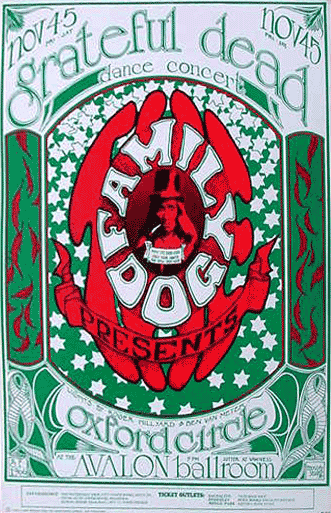
Family Dog original was designed by Victor Moscoso and Rick Griffin , It's for December 8-10 1967 shows at the Avalon Ballroom in San Francisco featuring the Jim Kweskin Jug Band, Sons of Champlin, and others.

Jim Kweskin and the Jug Band
by Craig Harris, All-Music Guide (http://www.allmusic.com/)
The fun side of folk music was explored by the Jim Kweskin Jug Band. During the five years that they were together, the group successfully transformed the sounds of pre-World War II rural music into a springboard for their good-humored performances.

Peanut Butter Conspiracy - Jim Kweskin Jug Band - Sparrow
1967 at Fillmore West Frisco
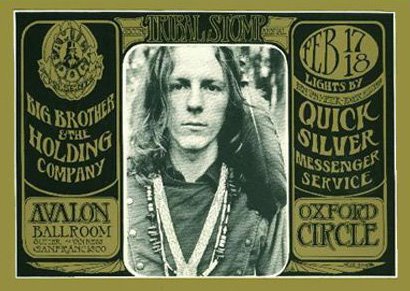
A communal-like musical ensemble, the Kweskin Jug Band was formed by Jim Kweskin, who had been inspired by a folk group, the Hoppers, featuring washtub bass player John "Fritz" Richmond. As a student at Boston University, Kweskin would often attend the Hoppers' performances at Cafe Yana in Harvard Square, learning much about guitar fingerpicking by watching the band's fingers. After Richmond was drafted into the U.S. Army, serving time in Korea and Europe, Kweskin began to frequent other folk clubs in Cambridge and Boston. Before long, he was playing guitar well enough to perform English and Appalachian ballads in folk coffeehouses. Jim Kweskin Jug Band,Big Brother and the Holding At Avalon Ballroom (San Francisco, CA) FD029-SG
Although Kweskin temporarily left for California, he returned to Cambridge, along with his wife Marilyn and dog Agatha, and resumed his musical career. A split-bill booking with blues enthusiast Geoff Muldaur at the Community Church in Boston on February 3, 1963, proved a turning point. In addition to peforming their own sets, Kweskin and Muldaur played several songs together. When Kweskin was invited by Maynard Solomon of Vanguard records to record with a band, he immediately remembered playing with Muldaur. Together with Fritz Richmond, and banjo and harmonica player Mel Lyman, Kweskin assembled the original Kweskin Jug Band. The group was a smash from the onset and were quickly signed to a record contract by Vanguard.

During a two week stint at the Bottom Line in New York, Maria D'Amato, fiddler and vocalist for the New York-based Even Dozen Jug Band, attended a show, became enamored of Muldaur and accepted an invitation to move to Cambridge and join the Kweskin Jug Band. D'Amato and Muldaur were soon married.
Shortly after the Kweskin Jug Band performed on the nationally-aired Steve Allen Show, on March 4, 1964, Lyman left the band and was replaced by banjo wiz Bill Keith, who had just left a gig with Bill Monroe's Bluegrass Boys.

The Kweskin Jug Band continued to bring their unique style of folk music to a national audience, appearing on The Roger Miller Show and The Al Hirt Show. Although Kweskin planned to move to California, the group left Vanguard and signed with Reprise, and virtuosic fiddler Richard Greene was added to the band. Just when it looked as though the Kweskin Jug Band was going to become commercially successful, Kweskin, who had moved into Lyman's commune in Fort Hill, a run down section of Boston, shaved off his trademark mustache and announced that he was breaking up the group.

In the aftermath of the Kweskin Jug Band's demise, Kweskin continued to work as a soloist, and he formed the U & I Band in the mid-1980s. Richmond went on to become a well-respected recording engineer and producer. Geoff and Maria Muldaur recorded several memorable duo albums before their marriage dissolved in the 1970s. Keith resumed his partnership with guitarist and vocalist Jim Rooney. In addition to working on each others' albums, Keith and Rooney were instrumental in the forming of a folk supergroup, the Woodstock Mountain Revue. Lyman, who ran his commune as a cult, disappeared under still-mysterious circumstances.


Add To Facebook

Σάββατο 28 Ιουνίου 2008

John 'Spider' Koerner ,Dave'Snaker' Ray & Tony 'Little Sun' Glover - Blues, Rags, and Hollers (1963)


''IN LOVING MEMORY OF DAVE RAY ''
Dave 'Snaker' Ray passed away at home in his sleep at 6:15 AM 11/28/02 R.I.P.

Koerner, Ray & Glover
“Spider” John Koerner. Dave “Snaker” Ray. Tony “Little Sun” Glover. The names are legendary, and the seminal country-blues trio they formed in the early Sixties influenced a musical era with its passionate treatments of rare blues stylings. A self-described fun-loving trio of misfits, they turned audiences on their heads with foot-stomping performances throughout the U.S., and their series of Elektra recordings, commencing with Blues, Rags and Hollers, are considered the cornerstone of the Sixties folk/blues revival. Though based in Minneapolis, Koerner, Ray and Glover first connected in New York City in the spring of 1962. Glover was visiting his pal Ray when Koerner dropped in from Upstate. Amidst the bar hopping and jamming, the three clicked, and the trio was born. By that fall, they were back in the Twin Cities, jamming and playing clubs and parties. In 1963, with the help of the editors of the Little Sandy Review, Koerner, Ray & Glover hooked up with Audiophile records in Milwaukee and in one twelve hour session, recorded Blues, Rags & Hollers. They sold several hundred records at gigs and put copies into the hands of a few influential people, including Jac Holzman at Elektra Records. When Holzman got around to listening to it he was blown away, and signed them to a recording contract. Elektra also bought the Blues, Rags & Hollers masters from Audiophile, but found that the album’s significant length posed mastering problems, and deleted four songs before releasing it in November.
Eventually, Koerner, Ray & Glover cut five albums for Elektra, with an intriguing mix of string-band, ragtime and down-home blues styles. They performed at the Newport and Philadelphia Folk Festivals as well as on the club and college circuit. Their raucous enthusiasm and musical acumen breathed life into traditional material and they earned fans that included John Lennon and the Doors. During the Sixties, Koerner kept up his solo career and in 1969 recorded the classic Elektra album Running, Jumping, Standing Still with Willie Murphy.
In the Seventies, he turned to other interests and moved to Denmark for several years. In Denmark, Koerner immersed himself in traditional American folk music. Falling in love with this genre, he began to forgo original compositions for traditional songs into which he infused his own interpretation, style and energy. Back in Minnesota in 1980, Koerner went into the studio with an outstanding group of sidemen that included Peter Ostroushko, Butch Thompson, Willie Murphy, Tony Glover, Dakota Dave Hull, and the Boston area’s bones-rattling wizard Mr. Bones. In one night while a tornado raged outside, the group recorded what has been described as one of the great folk records of all time. In late 1986, Red House released the session under the title Nobody Knows the Trouble I’ve Been. The critical response was unanimous, with accolades like “Comeback of the Year” and “Leave it to Spider John Koerner - Minnesota's premier blues picker - to salvage the soul of American folk music.” Today, Koerner is still exploring the range of folk traditions. There have been two more critically-acclaimed Red House recordings, Legends of Folk (with Utah Phillips and Ramblin’ Jack Elliott) and Raised By Humans. Red House also released a re-mastered, expanded CD version of the out-of-print Running, Jumping, Standing Still. Koerner’s rollicking treatments of traditional folk songs and self-penned classics seem to only get better and more seasoned with age.
During the Seventies and Eighties, Koerner, Ray & Glover reunited for special shows, including Folk Festivals in Winnipeg and Vancouver, and Sing Out! magazine’s thirtieth anniversary concert. One of their last trio shows in 1984 formed the foundation for Blues, Rags & Hollers: The Koerner, Ray & Glover Story, a two-hour performance documentary video produced by Glover. The Minnesota Music Awards named Koerner, Ray & Glover “Best Folk Group” and elected them to the Minnesota Music Hall of Fame along with Bob Dylan and Prince. Koerner and Ray & Glover’s recent recordings have only served to increase their legendary status, whetting the appetites of their long term fans and bringing a younger generation of music lovers on board. In response, Red House Records has secured the rights to Blues, Rags & Hollers for release on CD. In the process the four lost tracks that Elektra cut have been restored. The excitement generated by this release proves that the Little Sandy Review was remarkably prophetic when they predicted in 1963: “[Blues, Rags & Hollers] is a disc that will surely be a collector’s item in the future, as surely as the best blues of the 1930’s are collector’s items now.”
(RED HOUSE RECORDS)
This reissue has been digitallyremastered and includes all the tunes from the 1963 Audiophile release, including the four that Elektra dropped on their disc .

Red House's reissue of Blues Rags and Hollers, the first album from Koerner Ray & Glover, follows through on the folk and country-blues leanings of the blues revival. The result is a strong, catchy album that nevertheless sounds closer to folkies than the typical British blues record. — Thom Owen


heres the link
get it here ,enjoy

Add To Facebook

Τρίτη 24 Ιουνίου 2008

Jorma Kaukonen -78-02-04 Old Waldorf-San Francisco

Jorma Kaukonen (Solo-Acoustic)2/04/197 8Old Waldorf - San Francisco, Ca.

Show Notes: Very relaxed acoustic show. Very intimate setting with about 30-40 fans. Flanger used on several cuts. Next to perfect sound quality. Late Show. To my knowledge no other sources exist.

Jorma Kaukonen is one of the real legends of American rock. He started his career as an acoustic finger picker. He got his first taste of the main stream when he became a member of the San Francisco rock band, The Jefferson Airplane. He was inducted into the Rock and Roll Hall of Fame in 1995 as a founding member of the band. Jorma has released more than two dozen albums and has been a part of a number of ensembles. Jorma's most recent CD, "Blue Country Heart," demonstrates his love for bluegrass, country and old-time blues songs. Jorma also wants to give something back to society. He has combined his passion with his lifelong interest in teaching, this combination has resulted in Fur Peace Ranch, a successful guitar camp founded by Jorma and Vanessa Kaukonen in southeast Ohio.
Jorma Kaukonen was born in Washington, D.C. And he spent most of his childhood there. It is here that he discovered his love for the guitar. He shifted to the San Francisco Bay Area in the early '60s, here he often played as backup to singer Janis Joplin in local San Francisco clubs. It was in 1965 after Kaukonen founded the rock group Jefferson Airplane, that he really got fame. The band was a huge hit and its popularity soared in 1967. Though Kaukonen did not contribute as much in the vocal department of the band his distinctive guitar-playing was the core of the band's music.


Home is where the heart is!

Add To Facebook

Σάββατο 3 Μαΐου 2008

Sam Mitchell - Art of Bottleneck Slide Guitar (UK Folk Blues1991)


Sam was one of Europes finest bluesmen. His slideguitar playing was: Mean, witty, rough, soft, melodic. He turned me and a lot of other Danes on to blues and slideguitar. Sam was a fine musician. Where ever you are Sam I want to thank you for some damn fine music. (Finn Bjerke)

Sam Mitchell b. 1950 in Liverpool d. June 15, 2006 in Liverpool

Add To Facebook

Σάββατο 19 Απριλίου 2008

John Sebastian - I Want My Roots. (1996 US Jug Folk)


Life and career
His father, also named John Sebastian, was a noted classical harmonica player and his mother was a radio script writer. He is the godson of Vivian Vance (Ethel Mertz of I Love Lucy). He grew up surrounded by music and musicians, including Burl Ives and Woody Guthrie and hearing such players as Leadbelly and Mississippi John Hurt in his own neighborhood.
One of his first recording gigs was playing harmonica for Fred Neil on his Bleecker & MacDougal album in 1965. He came up through the Even Dozen Jug Band and The Mugwumps, which split to form the Lovin' Spoonful and the Mamas and Papas. Sebastian was joined by Zal Yanovsky, Steve Boone and Joe Butler in the Spoonful, which was named after a Mississippi John Hurt song. Sebastian also played autoharp on occasion.
The Lovin' Spoonful became part of the American response to the British Invasion and was noted for such folk-flavored hits as "Jug Band Music," "Do You Believe in Magic", "Summer in the City", "Daydream," "Nashville Cats," "Did You Ever Have to Make Up Your Mind," "Six O'Clock," and "Younger Girl." The band, however, began to implode after a 1967 marijuana bust in San Francisco involving Yanovsky, a Canadian citizen. Facing deportation, he gave up the name of his dealer, which caused a fan backlash and internal strife. Neither John Sebastian nor Joe Butler were involved in the matter - weren't even in San Francisco at the time.
Yanovsky left, replaced by Jerry Yester in 1967. Sebastian remained in the band but departed in 1968. He and the original band reunited to appear in the film One Trick Pony starring Paul Simon and Blair Brown.
Sebastian embarked on a moderately successful solo career after leaving the Lovin' Spoonful in 1968. Sebastian was popular among the rock festival circuits. He had a memorable, albeit unscheduled appearance at Woodstock, appearing after Country Joe McDonald's set, playing songs such as "I Had A Dream," "Rainbows All Over Your Blues" and "Younger Generation" which he dedicated to a newborn baby at the festival. Sebastian also returned for Woodstock '94, playing harmonica for Crosby, Stills and Nash. Sebastian released his eponymous LP John B. Sebastian in 1970, which featured him accompanied by various L.A. musicians.
In 1976, Sebastian had a number one single with, Welcome Back, the theme song to the Welcome Back, Kotter television show, which found new life decades later when a sample from it became the hook for rapper Mase's 2004 hit "Welcome Back". Recently, he has played with John Sebastian and the J-Band, a jug band including Fritz Richmond from the Jim Kweskin Jug Band, Yank Rachell, an original jug-band leader, and Geoff Muldaur. Rory Block Vocals, Guitar, Stompboard
Richard Crooks Drums
Yank Rachell Vocals, Mandolin
Annie RainesHarmonica, Backing Vocals
Fritz RichmondWashtub, Jug
Paul RishellVocals, Steel Guitar, Mandolin
John SebastianVocals, Guitar, Banjos Harmonica
John SimonHarmonium
Jimmy VivinoVocals, Guitar, Steel Guitar Mandolin, Autoharp
James Wormworth Drums, Washboard, Stompboard
Producer John Sebastian, Jimmy Vivino
Several modern musicians cite him as a large influence, including renowned blues harmonica player, Mike Tetrault. As a songwriter, Sebastian's songs have been covered by Elvis Costello ("The Room Nobody Lives In"), Dolly Parton, Del McCoury, Helen Reddy, Brenda Lee, Johnny Cash, Bobby Darin, Slade, Joe Cocker and Jimmy Buffett ("The Stories We Can Tell").
In later years, Sebastian hosted several television programs regarding '60s' music, including infomercials for compilations sets, and a half-hour program called The Golden Age of Rock and Roll, which was usually a video footage of various 1960's bands performing on various variety shows. He also hosted a Spoonful retrospective broadcast over PBS in March 2007, talking about various Spoonful numbers in between vintage video clips of the band up to the time he left.
In 2007, John released a guitar instructional DVD for Homespun Video teaching solo guitar adaptations of eight of his Spoonful hits including "Daydream", "Nashville Cats", and his solo hit "Welcome Back". He has also released an instructional DVD teaching beginning level autoharp. (Sebastian played both harmonica and autoharp on Shanachie's 2002 compilation CD "Man of Constant Sorrow".)
Sebastian and the J Band appear in the documentary about the roots and influence of jug band music, Chasin' Gus' Ghost, which screened in August 2007 at the San Francisco Jug Band Festival and made its film festival debut in October 2007 at the Woodstock Film Festival. In the film, Sebastian humorously explains, with musical accompaniment, how his hit song "Younger Girl" was inspired by Gus Cannon's "Prison Wall Blues." He also performed at the festival with other musicians featured in the film, including Geoff Muldaur, Maria Muldaur, Jim Kweskin and David Grisman.
Sebastian played harmonica with The Doors on the song Roadhouse Blues under the pseudonym G. Puglese to avoid problems with his contract, which was featured on Morrison Hotel album, also played on "Little Red Rooster" on the live album Alive, She Cried and on seven songs on Live In Detroit. He is also credited with playing harmonica on Crosby Stills Nash & Young's "Déjà Vu" from the album of the same name.

Add To Facebook

Τετάρτη 26 Δεκεμβρίου 2007

Davy Graham "Large As Life and Twice As Natural" (Decca Rec.1968)

(Original covers)
Davy Graham "Large As Life and Twice As Natural" 1968

Davy Graham: guitar, vocals
Dick Heckstall-Smith: saxophones
Jon Hiseman: drums
Harold McNair: flutes
Danny Thompson: bass

This is Davy Graham's third adventure on an LP …and along roads that are folk, blues, jazz, Arabic, Indian-and one or two more things. Travelling with a guitar and also Danny Thompson, bass Jon Hiseman, drums, Harold McNair, flutes, and Dick Heckstall-Smtih, saxophones. Travelling like Baudelaire's travellers; 'who move simply to move'. The man himself is equally at home in Edinburgh ('a stately city'); Glasgow ('such warm acid'); or in Athens ('gold and purple in the evening. Smooth as marble hollow solid eyes of panthers. So exhausting for strangers.') But he is never at home in any one place for very long. And this seems to be in exact parallel with his music. For he cannot be pigeonholed: fortunately.
(CD Sleeves)
He is a life-member on the roundabout of alteration. Like his deep-down blues, and you have to accept his setting of a 1000 year old Romeo and Juliet story. Go with him on a musical flight to Morocco ('Jenra' : pavilion'd in splendour) and the return journey will be via an extended raga. But always-I should add-in the company of originality. For after introducing North African music to Western guitar, he has now done the same for India. It's a bit like Dr Bannister running his 4-minute mile and then going off in search of another distance. All of which is quiet disparate, but also very thorough and exciting and satisfying. In the past few years Davy has played his folk at the Edinburgh Festival, his jazz in some of the best clubs in London, his Arabic interpretations in Tangier and his ragas to people who know Ravi Shankar's records. (Unlike those who have gone to India for a 3-week Sitar course, he has investigated the form of ragas.) So far nobody who has listened has found his music a disappointment. And certainly not the many who have brought his two previous LPs.
Following this later collection I know have no idea where his next stop will be. He might take a bicycle to Mexico or slip inside a carrier pigeon's message to Senegal. Or it could be Canterbury. At least I know it will be fascination though as his producer of records, apart from supervising the sessions, I have found myself becoming more and more an editor of the ideas, which zoom out from him like flying saucers, with there origins just as mysterious. He will sometimes break off in the middle of a 'take' that another guitarist might become a Faust for, to tell me about three points of recording and it is preserved there for everyone to buy-he rarely performs it before an audience again. "I have to avoid the cliche," he says. "I want to keep them on the move…"Well on behalf of those of us who have done cur best to keep up with him. I hope he does. Original sleeve notes by Ray Horricks.
01. Both Sides Now (Mitchell)
02. Bad Boy Blues (Trad.; Arr. Graham)
03. Tristano (Graham)
04. Babe, It Ain't No Lie (Trad.; Arr Graham)
05. Bruton Town (Trad.;Arr Graham)
06. Sunshine Raga (Graham)
07. Freight Train Blues (McDowell)
08. Jenra (Graham)
09. Electric Chair (Unknown)
10. Good Moring Blues (Trad.; Arr. Ledbetter)
11. Blue Raga (Graham)
(First Time Posted At : 'Time Has Told Me' By Lizardson)
------A Marvellous Blog-----


Add To Facebook

Τρίτη 6 Νοεμβρίου 2007

Tony Joe White - Continued (1969 Monument Rec.)


Tony Joe White Guitar, Harmonica, Vocals
Tommy McClure Bass
Mike Utley Organ
Sammy Creason Drums
James Milhart Drums


Produced by Billy Swan
Recorded at Monument Studios, Nashville / Lyn-Lou Studios, Memphis 1969


This album was re-released on bootleg-CD by Movieplay/Intermusic from Portugal in 1993 with a different cover and another title (Roosevelt And Ira Lee).


The second photo shows the CD cover. Another re-release in 1997 by Warner Bros. also contained two additional songs - 'Watching The Trains Go By' (by Dewey Oldham and Wallace Pennington) and 'Old Man Willis' (by Tony Joe White himself) were the second single. 'Old Man Willis' was later re-recorded for the album '...Continued'.


In 1969, Tony Joe White from Louisiana had a U.S. Top 10 hit with his classic swamp rock song "Polk Salad Annie," followed in 1970, by Brook Benton’s soulful rendition of White's timeless "Rainy Night In Georgia."


In late September 1973, White was recruited by producer Huey P. Meaux to sit in on the legendary Memphis sessions that became the landmark Southern Roots album of Jerry Lee Lewis.
By all accounts, these sessions were a three day, around the clock party, which not only reunited the original MGs (Steve Cropper, Donald "Duck" Dunn and Al Jackson Jr. of Booker T. and the MGs fame) for the first time in three years, they also featured rockabilly icon Carl Perkins, Mark Lindsay (of Paul Revere and the Raiders), and Wayne Jackson and The Memphis Horns.
Throughout the 1970s and 1980s White toured in support of artists including Creedence Clearwater Revival and James Taylor. In the 1990s Tina Turner recorded four of his songs for her multi-platinum selling album Foreign Affairs, including the world-wide hit "Steamy Windows". With the advent of that project, White formed an alliance with Turner's manager, Roger Davies and his career began to soar.


In Europe White gained legendary status following a successful debut at the historic Isle of Wight Festival in 1970. In 1991 he signed with Remark, issued the Closer To The Truth album and spent the next two years touring Europe in support of Eric Clapton and Joe Cocker, among others. He cut two more albums for Remark, 1993's Path Of A Decent Groove and 1995's Lake Placid Blues, the latter garnering the first of two nominations for "Best R & B Album" from the Nashville Music Awards, (the second being, The Best Of Tony Joe White, a 1996 retrospective of his work on Warner Brothers). French audiences eagerly embraced White as the ‘Swamp Fox’ and in 1998, he became the subject of a French produced documentary: Tony Joe White-The Man From Down South.
In 1999, White went back to his roots and recorded One Hot July, in the swamps of Louisiana. He then toured Australia and Europe once again in support of the critically acclaimed album. In 2001, Audium and Koch Entertainment released The Beginning - a stripped-down acoustic album that received worldwide recognition and five star ratings in virtually every country.
Throughout the years, White has had songs recorded by dozens of major artists including Elvis Presley, Ray Charles, Joe Cocker, Etta James, Hank Williams Jr., Tim McGraw, John Mayall and Waylon Jennings. More recently, he has worked with Marc Bryan of Hootie & The Blowfish and Michael McDonald. He has written and performed jingles for McDonalds and Levi's 501 Blues and been featured on movie soundtracks for Millennium, Selena and Hotspot. His music has also been featured in two HBO original films.
His most recent CD release is Heroes and Heroines, on his own label, Swamp Records. White says he created the company with his son Jody White, so that he could continue to produce music his way.
Rory Gallagher did a cover of his song "As The Crow Flies" on his live album Irish Tour.
Band Southern Culture On The Skids pays tribute to White in their 1996 song "Voodoo Cadillac" (arguably the best listening song ever recorded for cruising, with your baby of course, in a 2002 Champagne DeVille) with the first stanza lyric: "Come on baby, take a ride with me / Up the Mississippi, down to New Orleans / Tuck and roll, FM stereo / Got some Tony Joe White on my radio".
In 2005 UK blues singer Elkie Brooks covered Tony's Out Of The Rain releasing it as a single and featuring it on her album Electric Lady. The version is now a staple of Elkie's repertoire and was even given the seal of approval by Tony himself. Coincidentally Elkie had recorded an old number of White's, Aspen, Colorado in her first Rock band DADA in 1970.
One of his most recent performances was on July 14, 2006 in Magny-Cours, France, as a warm-up act for Roger Waters' Dark Side of the Moon concert. His new album entitled "Uncovered" is due out September 2006 and features collaborations with Mark Knopfler, Michael McDonald, Eric Clapton, Waylon Jennings & Shelby Lynne


Add To Facebook